
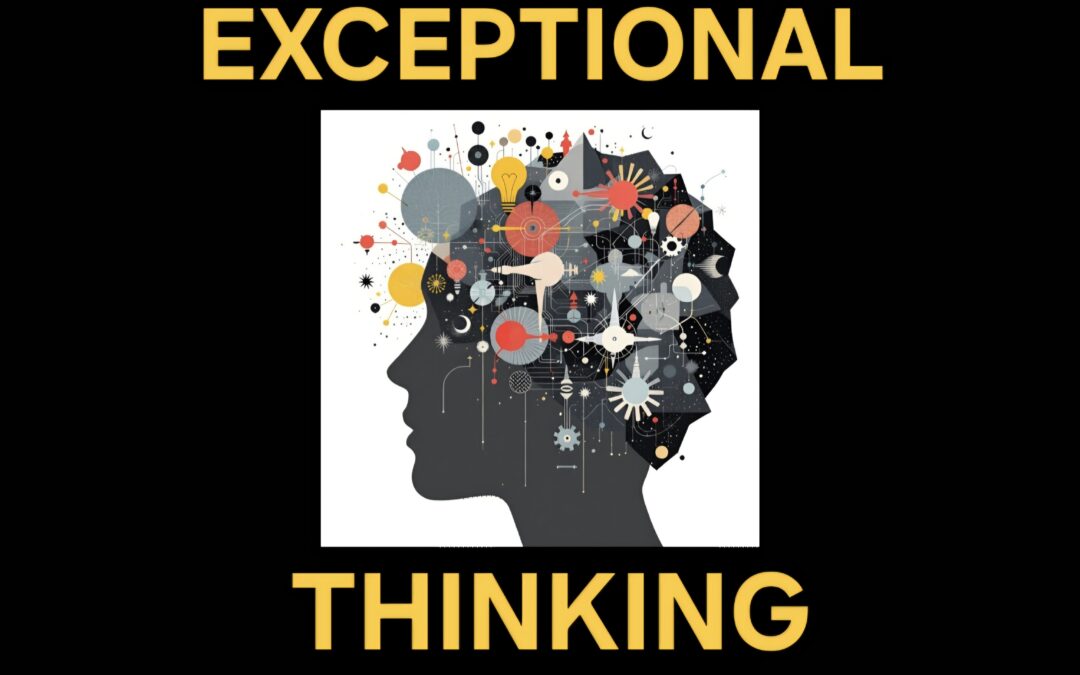
The world’s most capable minds, from the quiet warriors of American Special Forces to the tragic heroes of Shakespeare, all share a single discipline: The ability to think beyond the obvious. “Exceptional thinking” is their compass. It is the art of seeing from multiple angles; of holding competing truths; of stepping into uncertainty without flinching. The natural courage to ask is, “What else might be true?” The foundations of “exceptional thinking” are the actions that solve problems, not by force, but by imagination.
As an author, I have always written from the same impulse – not to be exceptional – never that. But to look beyond the obvious. I sit with questions that do not yield easy answers. My work has never been about declaring truth. It is about circling it; listening for it; letting it reveal itself in its own time. That approach mirrors the discipline of those who think deeply. Examples include the American warriors, who analyze every angle, and the Shakespearean characters who wrestle with competing realities. But in a world where quick opinions drown out quiet inquiry, even this kind of exploration becomes hard to sustain. The noise of uncertainty obstructs the slower, more honest search for what might actually be true. Within that space, exceptional thinking shrinks.
My message: When the truth is intentionally obscured, our mind loses its reach. Without the ability to reach, all of us lose the capacity to think beyond the obvious.
 Bud Megargee is a former senior behavioral healthcare executive; a Washington, DC., healthcare lobbyist; and an independently published, best-selling and award-winning author. He began writing after exploring Eastern philosophy and alternative medicine techniques in the professional treatment of emotional challenges at a Taiwanese Buddhist monastery.